
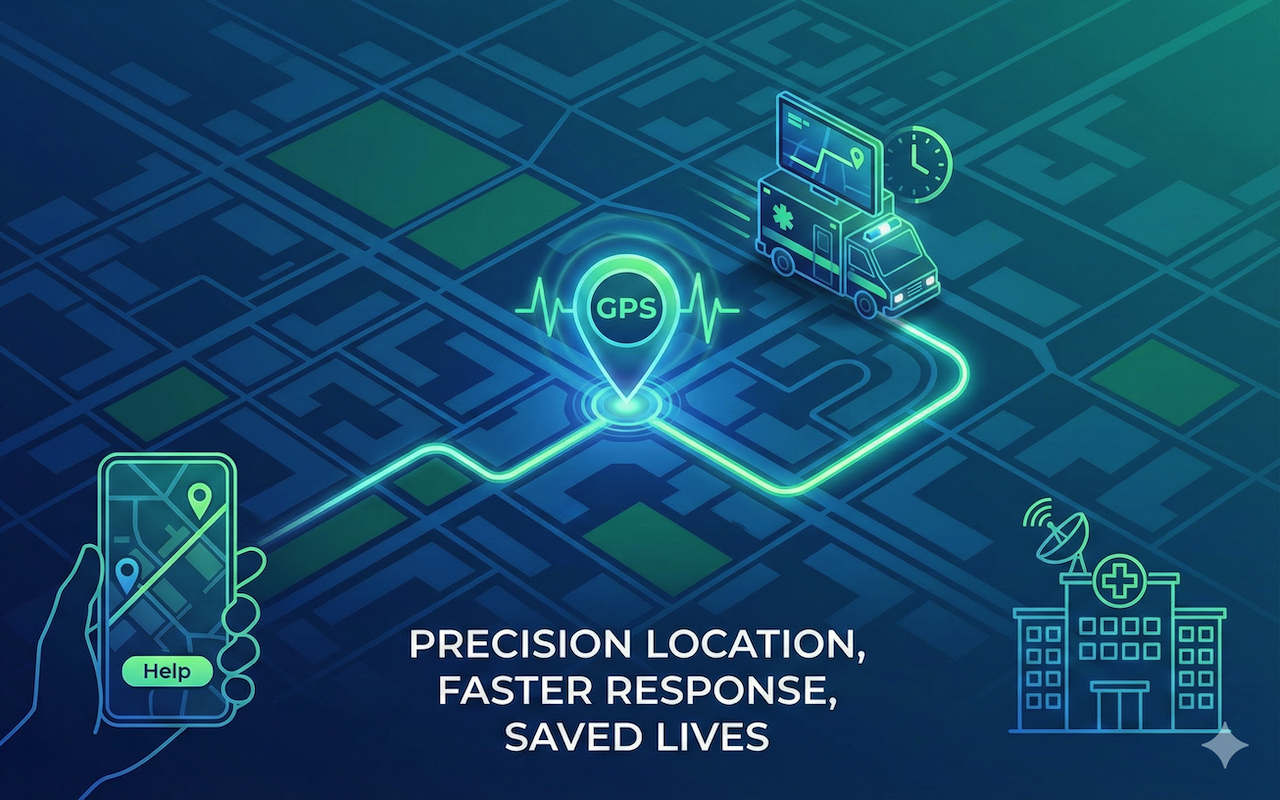
Time is an unreplenished resource during a medical emergency. It could be a cardiac arrest, a car accident, or a highway crash, but the time spent getting the patient's assistance is frequently the largest determinant of survival. However, most of the delays in emergency medical services (EMS) do not concern medical proficiency or ambulance access! Their root cause lies in something much more basic: failure to find the patient fast and precisely.
Geolocation technologies have quietly become the unseen powerhouse that greatly reduces these delays. Geolocation is revolutionizing the speed and effectiveness with which emergency care is delivered to the population by enhancing location accuracy, refining dispatch decisions, and connecting hospitals and ambulances in real time.
This article examines the core innovations making that possible, supported by both fundamental research and practical experience.
Precision Location: The Foundation of Rapid Emergency Care
Why is it more difficult to determine the precise site of an accident or emergency case than it sounds? Even coherent communication is difficult in distressing situations. The callers might be unaware of their exact address, lost, or panicking. A verbal description on the highway, country roads, isolated areas, or dense clusters of buildings can cause significant deviations, which cost valuable minutes.
Geolocation eliminates this vulnerability. GPS and hybrid positioning locate the precise coordinates immediately instead of forcing callers to describe the location, eliminating the largest initial response gap in EMS.
Real Evidence: How Much Does Geolocation Save?
A pilot study comparing verbal reporting with automated geolocation showed a dramatic difference between the two:
- The median location error of manual verbal reporting was about 1,173.5 meters.
- The automation of geolocation minimized that error to approximately 65.6 meters.
- More importantly, the time to first medical intervention was reduced by approximately 40 seconds (122.6 → 83.0 seconds) when automatic geolocation was used.
Another study of geolocation data on EMS established that:
- The location with GPS was within a range of accuracy in the outdoors of ~ 2.0 ± 3.3 m.
- Geolocation with Wi-Fi was working well indoors with around 7.0 ± 24.1 m accuracy.
These are not marginal benefits—they are life-saving advantages during the earliest stage of emergency response. In addition to these technological advancements, civil preparedness reinforces results as well. Through organizations such as the American CPR Care Association, more individuals are trained to act efficiently, and geolocation allows EMS to gain access within a shorter time.
The Importance of Geolocation During Real Emergencies
- Unconscious or confused patients no longer need to verbally describe their location.
- Multilingual barriers are no longer a hindrance to dispatch.
- Remote or unmarked roads are easier to locate in case of accidents.
- Congested cities with two buildings of identical landmarks can also be easier to navigate for EMS.
- Geolocation makes the uncertainty a fact of action in a few seconds.
Smart Dispatch, Routing, and Proactive Ambulance Positioning
Location is the first step. However, it is geolocation that enables EMS to transform that information into rapid, coordinated action.
Dynamic Routing: Sending the Fastest Ambulance, Not the Nearest
Contemporary EMS is integrated with geolocation and traffic information, live GPS positioning of ambulances, and an AI-proposed route optimization. Rather than allocating a vehicle based on its physical proximity, the system evaluates:
- Current traffic
- Road conditions
- Predicted congestion
- Shortest time, not shortest distance
A recent study comparing hybrid GIS + routing optimization showed a 22-28% reduction in ambulance response times compared to traditional dispatch approaches.
This implies that an ambulance that previously took 12 minutes could now arrive within 8.5 to 9 minutes — a significant improvement in time-critical emergencies such as trauma or cardiac arrest.
Tactical Ambulance Placement: Emergency Predictability
Geolocation is not only responsive; it allows planning in the long term. EMS authorities can analyze:
- Historical emergency hotspots
- Time-of-day emergency surges
- Traffic flow
- Population density
- Accident-prone corridors
One of the largest cities that implemented such geospatial-time analysis has seen the deployment points rise from 17 to 32, without providing more ambulances.
The result?
- The median response time decreased from 10.1 minutes to 7.1 minutes.
- Inbound calls answered in 8 minutes or less increased from 22.3% to 47.3%.
- Another simulation study established that with GIS-based ambulance positioning, 94% of calls achieved the 8-minute standard, which was dramatically better than traditional models.
These upgrades do not need any new infrastructure, but rather smarter positioning based on geolocation data.
Geo-Routing: High-Impact Scenarios
- Dense cities with unpredictable traffic
- Rural stretches with unclear markers
- Hilly terrains where the distance is not equal to time
- Activities or celebrations where human congestion can cause delays
- Poor visibility in nighttime emergencies
Geolocation-based dispatch equalizes response time variability to different situations.
Why Has Geolocation-Based EMS Become a Necessary Part of Modern Healthcare?
Geolocation is not only a technological upgrade! It is the foundation of a solid emergency environment.
Quick Intervention Significantly Saves Lives
In emergencies such as cardiac arrest, every minute without intervention reduces survival by 7–10%. Even a 2–3 minute reduction in response time can double a patient’s chances of survival.
A rural EMS study has found that with the introduction of GPS navigation:
- Mean response time was reduced to 7.6 minutes.
- This is of particular importance in rural or underserved areas.
Improved Hospital Preparedness and Care Chains
With the real-time tracking of ambulances:
- Hospitals know exactly when a patient will arrive.
- Emergency departments mobilize teams faster.
- Trauma rooms are prepped without delay.
- Reduced handover times.
- Several facilities can manage capacity during high load.
A geolocation-based EMS platform forms a bridge between home–ambulance–hospital, making each step more efficient.
Scalability of Each Geography
Geolocation solutions are flexible since they do not require the costly physical infrastructure. They can work through:
- GPS
- Wi-Fi
- Cell tower triangulation
- Hybrid location algorithms
They are a big source of reducing location friction, whether in urban areas or rural strips.
Enhanced Ecosystem Through Public Training Organizations
Emergency systems are best served when professional EMS and public action meet halfway. Trained bystanders initiating CPR promptly, and the arrival of EMS via geolocation is faster, which increases survival rates more than either one alone can achieve.
This is a combined strategy (bystander action + smart EMS + hospital readiness) that will become the future of emergency care.
Summary: Geolocation – The Silent Life-Saving Force
The strength of geolocation is its simplicity: it eliminates delays that should not have been. Geolocation innovation is reinventing fast in emergency response by making location detection instant, dispatch intelligent, routing dynamic, and hospital coordination smooth.
With an increase in population density and more complicated medical emergencies, the healthcare systems cannot afford to use an old address-based dispatch. Geolocation is not an optimization; it is a requirement. It allows the healthcare system to be fast, precise, and ready when a person calls in need of assistance.
To EMS planners, policymakers, public health authorities, and training organizations, geolocation is more advantageous at each stage of emergency care and a key to saving more lives.
Featured Image generated by Google Gemini.
Share this post
Leave a comment
All comments are moderated. Spammy and bot submitted comments are deleted. Please submit the comments that are helpful to others, and we'll approve your comments. A comment that includes outbound link will only be approved if the content is relevant to the topic, and has some value to our readers.
Comments (0)
No comment