
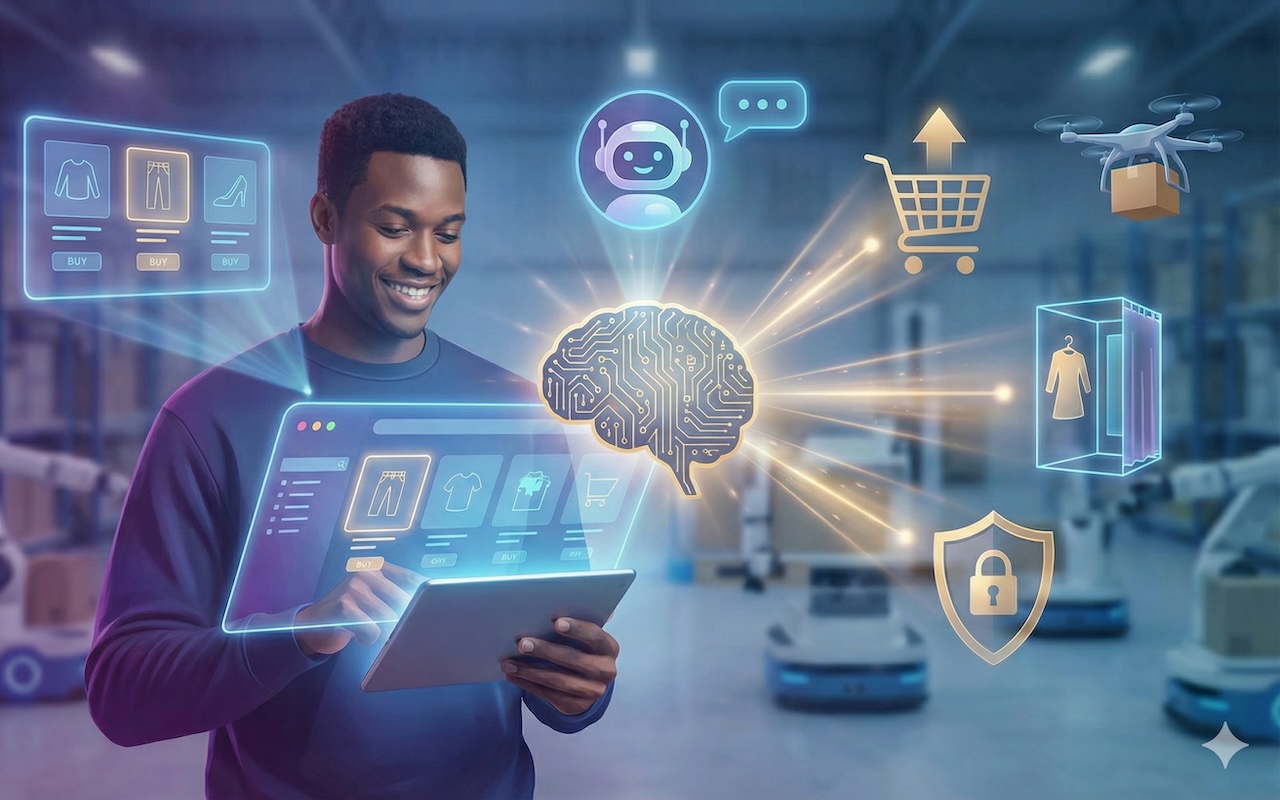
As the market expands and opens up to higher-value digital exchanges, eCommerce leaders face the issue of managing their rising customer expectations consistently. And this is all amid a situation where brands are competing to win customer attention, trust, and engagement in digital markets. This is why traditional digital strategies no longer work, as they cannot support leaders in meeting real-time user demands. So, to allow a more personalized product discovery, recommendations, and user decision-making, AI is being put to use by corporations.
Powering this transformation, AI in eCommerce enables businesses to understand user intent, personalize their transactions and interactions, allow a seamless UX, and assist in smarter user decisions online. Moreover, brands can now predict their users’ needs and adapt their platforms to deliver unique digital experiences that feel effortless and relevant. So, as it moves to smart search, dynamic pricing, and automated support, AI is redefining how modern digital commerce operates. With this in mind, this article explores how AI is reshaping and improving customer experiences in the eCommerce market in 2026.
The Role of AI in Enhancing Customer Experience in the eCommerce Market
There is no doubt that artificial intelligence plays a pivotal role across industries and has changed the game in the eCommerce markets as well. Herein, AI is redefining user experience by making it faster, smarter, and more unique.
For instance, when a user opens the app, it is able to reflect what they searched for last, while sharing insights about what is trending. This makes the app engaging and interesting for them.
In this manner, eCommerce labels are using customer data insights to improve their online offerings with adaptive product discovery, chatbot support, predictive analytics, and optimized backend operations that reflect on the UX.
Hence, with these extended AI-powered capabilities, eCommerce brands have an opportunity to deliver seamless, data-driven user experiences. Eventually, this also boosts user satisfaction and loyalty while ensuring their long-term growth.
Key Ways AI Improves Customer Experience in eCommerce
Today, eCommerce platforms are enhancing their capabilities using AI to adapt, predict, and respond to users in real time. This is because AI is a powerhouse helping them optimize their operations through automation, intelligence, and personalization.
With this in mind, this section explores the key ways in which AI in eCommerce enhances customer experiences.
1. Gen AI for Personalized Product Recommendations
Gen AI is a subset of AI that can create new content by learning patterns from historical data records. Hence, it helps brands analyze users’ real-time browsing patterns, past purchases, search behavior, and engagement signals. Based on these insights, it delivers dynamic recommendations across modern websites, mobile apps, the search bar, and various email campaigns. As a result, users can easily discover products that match their intent, reducing decision fatigue. This also leads to higher engagement and increased average order value (AOV) for the platforms.
2. Chatbots and Virtual Assistants in Customer Support
Another modern development reshaping customer services has been the evolution of chatbots and virtual assistants. Essentially, bots are equipped with responses to common user queries, which helps them manage tasks without human intervention. And when assistance is needed, the support is transferred to human agents. Overall, bots streamline the process, improve response times, and reduce the wait periods. Additionally, virtual assistants help users with their buying decisions and assist with navigation. As a result, drop-offs are reduced, ensuring a seamless user journey.
3. Predictive Analytics for Better CX
There is no doubt that AI can process a huge volume of customer data quickly and predict customer intent in real-time. This data is usually based on their purchase behavior, searches, and more. Further, this analysis helps brands plan their inventory, tailor user-specific promotions, and proactively personalize interactions. Mainly, it helps management refine their user retention strategies while ensuring customers receive the right offers at the right time. Hence, predictive analytics can be considered a powerful tool that helps optimize eCommerce performance and streamline business operations.
4. Visual and Voice Commerce
Today, many eCommerce brands use AI-powered features to make product discovery easier and interesting for users. These may include image-based search, AR try-ons, and visual product recognition. Apart from that, AI in e-commerce also helps incorporate voice-based commerce, such as Alexa or the Google Assistant, to help shoppers find similar products online. Overall, these capabilities enhance user accessibility and create smoother, hands-free shopping experiences for the target audience. From a business perspective, this is a key factor in enhancing a brand’s online engagement.
5. Fraud Prevention and Secure Checkout Experience
Intelligent threat detection is a necessary add-on for the eCommerce platforms today. This is why many leaders are investing in enterprise-grade cybersecurity measures, including AI to detect anomalies in real time. This precision-focused assessment reduces payment failures by identifying risky behavior before it affects the customer. Moreover, it leads to a faster, more secure checkout flow and protects users from fraud. So, the result is higher user trust and lower friction in the most critical stage of the buying journey, i.e., the payment page.
How AI Elevates Overall eCommerce Performance
Focusing on improving customer experience, eCommerce brand owners often look at how integrating AI into the platform infrastructure can add to their revenue streams. To gain more insights about this subject, this section briefly shares how AI can improve a brand’s performance in the eCommerce markets. By providing personalized recommendations, eCommerce companies improve their user experience and can even make it as good as the in-store one. What’s more, businesses can focus on scalability and long-term growth by leveraging AI to improve their user-focused strategies for 2026. Overall, AI helps brands boost engagement, retention, and customer loyalty.
Final Thoughts
From personalization to boosting online sales, AI is redefining how brands interact with their users online. This is possible by making the eCommerce market intelligent, adaptive, and experience-driven. Comprehensively, this technology empowers brands by strengthening both their front-end experience and the platform’s operational capabilities. Herein, AI fosters businesses to grow efficiently while building deeper customer loyalty. So, for leaders aiming to stay competitive in 2026 and beyond, an AI-driven customer experience is not just an enhancement. Indeed, it is a strategic foundation for sustainable digital success.
Featured Image generated by Google Gemini.
Share this post
Leave a comment
All comments are moderated. Spammy and bot submitted comments are deleted. Please submit the comments that are helpful to others, and we'll approve your comments. A comment that includes outbound link will only be approved if the content is relevant to the topic, and has some value to our readers.
Comments (0)
No comment