
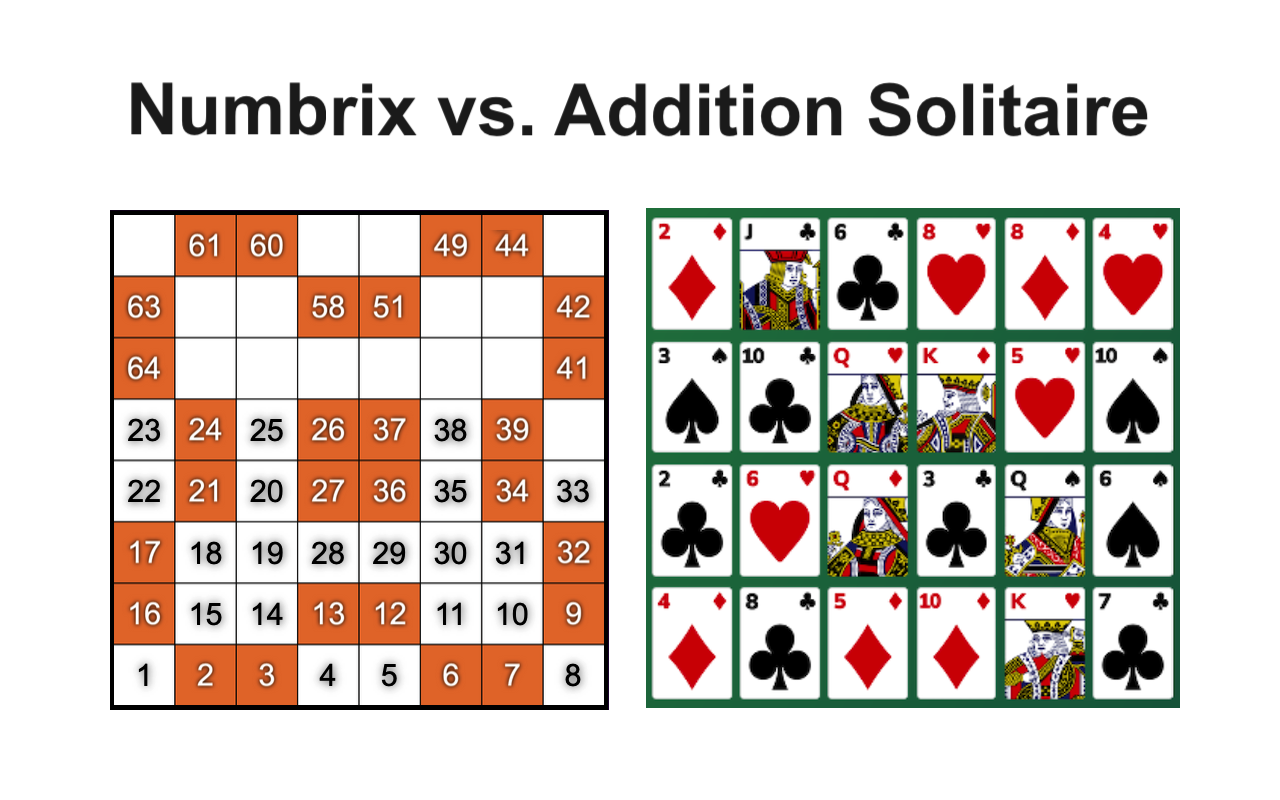
Puzzle and logic games have long been a favorite pastime for those who enjoy exercising their minds. Two titles stand out for their ability to captivate minds and challenge strategic thinking: Numbrix and Addiction Solitaire. While one focuses on building logical number sequences, the other pushes players to carefully arrange cards within strict rules. This comparison explores what makes each game unique and helps determine which might be the perfect fit for your puzzle-solving preferences.
What is Numbrix?
Numbrix, created by puzzle master Marilyn vos Savant, presents players with a deceptively simple challenge: fill a grid with consecutive numbers that connect horizontally and vertically in an unbroken chain.
How it works:
- Played on a square grid (often 9x9).
- Numbers are placed randomly, and the player’s task is to fill in the blanks so that all numbers from 1 to the maximum grid size (81 for 9x9 grid) connect sequentially.
- Numbers must be placed adjacent horizontally or vertically—no diagonal moves are allowed.
Key Features of Numbrix:
- Sequential Logic: Every move must maintain numerical order
- Path Planning: Success requires visualizing the entire route
- Mathematical Foundation: Based on Hamiltonian path theory
- Scalable Difficulty: Available in various grid sizes
- Single Solution: Each puzzle has one correct answer
The appeal of Numbrix lies in its mathematical elegance. Players must think several moves ahead, considering how their current placement affects the entire numerical sequence. It's chess-like in its demand for strategic foresight, yet accessible enough for anyone comfortable with basic counting.
What is Addiction Solitaire?
Addiction Solitaire, also known as Gaps or Montana, transforms the traditional deck of playing cards into a spatial puzzle. The game begins with all 52 cards laid out in four rows of thirteen, with the Aces removed to create gaps. Players must rearrange cards by suit in ascending order, using the empty spaces strategically.
How it works:
- Played with a standard 52-card deck.
- Aces are removed, leaving four empty spaces—or “gaps.”
- The goal is to rearrange the remaining cards into four suit-based sequences running from 2 to King.
- Only certain moves are allowed: cards can be placed into a gap if they follow the card of the same suit already positioned to the left.
- Most versions allow a limited number of reshuffles (usually 2–3).
Key Features of Addiction Solitaire:
- Suit-Based Organization: Cards must be arranged by suit in sequence
- Gap Management: Empty spaces are the key to movement
- Strategic Blocking: Poor moves can create unsolvable situations
- Multiple Solutions: Various paths can lead to success
- Restart Mechanics: Most versions allow reshuffling when stuck
Addiction Solitaire demands spatial reasoning and tactical planning. Unlike traditional solitaire games that focus on revealing hidden cards, this variant requires players to manipulate visible information, making every decision transparent but no less challenging.
Comparing Gameplay Mechanics
At their core, Numbrix and Addiction Solitaire offer very different experiences:
- Numbrix: A deterministic puzzle—every challenge has a logical solution, and success depends on reasoning alone.
- Addiction Solitaire: A blend of skill and chance—strategy matters, but luck determines the starting layout and reshuffle outcomes.
- Style and pace: Numbrix requires patience and methodical thinking, while Addiction Solitaire has a faster pace and feels more dynamic, often creating tension as reshuffles run out.
1. Learning Curves
Numbrix presents a steeper initial learning curve. New players often struggle with the concept of creating a continuous numerical path, especially in larger grids. However, once the basic principles are understood, improvement tends to be steady and measurable.
Addiction Solitaire offers more immediate accessibility. Most people understand the basic mechanics quickly, but mastering the strategic depth takes considerable practice. The game's familiarity with standard playing cards helps reduce the initial barrier to entry.
2. Mental Skills They Develop
Both games sharpen the mind but in distinct ways:
- Numbrix develops logical reasoning, number sequencing, and focus. Solving puzzles often feels like building a clean chain of logic, one step at a time.
- Addiction Solitaire trains pattern recognition, forward planning, and adaptability. Players must think ahead, anticipate possible gaps, and adjust to unexpected reshuffles.
3. Pacing and Flow
Numbrix encourages a contemplative, methodical approach. Players often spend considerable time analyzing possibilities before making moves. This deliberate pacing creates a meditative quality that many find relaxing despite the mental challenge.
Addiction Solitaire supports both quick, intuitive play and careful deliberation. The ability to make rapid moves when obvious opportunities arise, combined with the need for strategic thinking in complex situations, creates a more varied rhythm.
4. Time Commitment
A typical Numbrix puzzle might take anywhere from 15 minutes to over an hour, depending on grid size and difficulty. This makes it suitable for extended problem-solving sessions but less ideal for quick gaming breaks.
Addiction Solitaire games typically conclude within 10-30 minutes, making them perfect for shorter entertainment periods. The ability to restart quickly when stuck supports multiple gaming sessions within limited timeframes.
5. Frustration and Satisfaction
Both games can generate significant frustration when players become stuck, but they handle this differently. Numbrix puzzles always have solutions, so persistence will eventually pay off. The satisfaction of completing a challenging Numbrix grid is often described as deeply rewarding due to the mental effort required.
Addiction Solitaire can sometimes reach genuinely unsolvable states, leading to necessary restarts. However, this unpredictability can also increase excitement when breakthrough moments occur. The game's shorter typical duration makes multiple attempts less daunting.
6. Difficulty & Replay Value
Numbrix gradually increases in difficulty as grid sizes grow. Each puzzle has one correct solution, making it satisfying to “crack the code.” Replay value comes from fresh daily puzzles.
Addiction Solitaire is infinitely replayable thanks to randomized deals. Some games are challenging, others unwinnable, but that unpredictability keeps players hooked.
7. Cognitive Benefits
Numbrix excels at developing sequential reasoning skills and mathematical thinking. Regular play can improve number sense, logical deduction abilities, and systematic problem-solving approaches. These skills transfer well to academic and professional contexts requiring structured thinking.
Addiction Solitaire strengthens spatial reasoning, pattern recognition, and tactical planning abilities. The game's emphasis on managing limited resources (the gaps) and adapting to changing situations provides valuable cognitive exercise for real-world problem-solving.
8. Who Will Enjoy Each Game?
- Numbrix: Ideal for puzzle enthusiasts, fans of Sudoku, or those who enjoy structured, logic-based problem-solving.
- Addiction Solitaire: Best suited for card players, Solitaire lovers, and anyone who enjoys a mix of skill and luck in their challenges.
In short, Numbrix attracts logical thinkers, while Addiction Solitaire appeals to strategic risk-takers.
Similarities Between the Two
Despite their differences, Numbrix and Addiction Solitaire share some common ground:
- Both are easy to access online and playable directly in the browser.
- Both focus on simplicity in design but depth in challenge.
- Both are perfect for short, engaging play sessions when you want to exercise your brain without a huge time commitment.
Conclusion
Numbrix and Addiction Solitaire are very different in design but equally effective at delivering mental workouts. Numbrix emphasizes pure logic and number sequencing, while Addiction Solitaire combines strategy with chance for a dynamic card-based challenge.
Whether you prefer the certainty of solving puzzles step by step or the thrill of outsmarting a shuffled deck, both games prove that exercising your mind can be fun, engaging, and even addictive.
Share this post
Leave a comment
All comments are moderated. Spammy and bot submitted comments are deleted. Please submit the comments that are helpful to others, and we'll approve your comments. A comment that includes outbound link will only be approved if the content is relevant to the topic, and has some value to our readers.
Comments (0)
No comment