

You generated AI text, but it fails a plagiarism check, or perhaps you simply do not like the way it sounds? A quick synonym swap will not solve the issue. To address this properly, you need techniques that go deeper and reshape the text into something more original and natural. Today, we will share several methods that, in our experience, work best and consistently deliver plagiarism-free, human-like results.
What Counts as Plagiarism in AI-Generated Text?
Before we look at AI, it helps to define plagiarism in general. At its core, plagiarism is the act of presenting someone else’s words as your own without proper acknowledgment. It can take many forms: a writer copies text word for word, paraphrases too closely to the original, reuses ideas and research without proper acknowledgment, or presents someone else’s structure and argument as their own. In academic and professional settings, plagiarism is treated as a serious offense because it undermines trust and disrespects intellectual property.
When it comes to AI-generated text, the concept of plagiarism gets a little trickier because the machine isn’t “stealing” on purpose. Still, the end result can be too close to existing sources, and that’s what matters. To keep ourselves on safe ground, we need to understand the different types of plagiarism and why AI makes it easier to slip into those pitfalls.
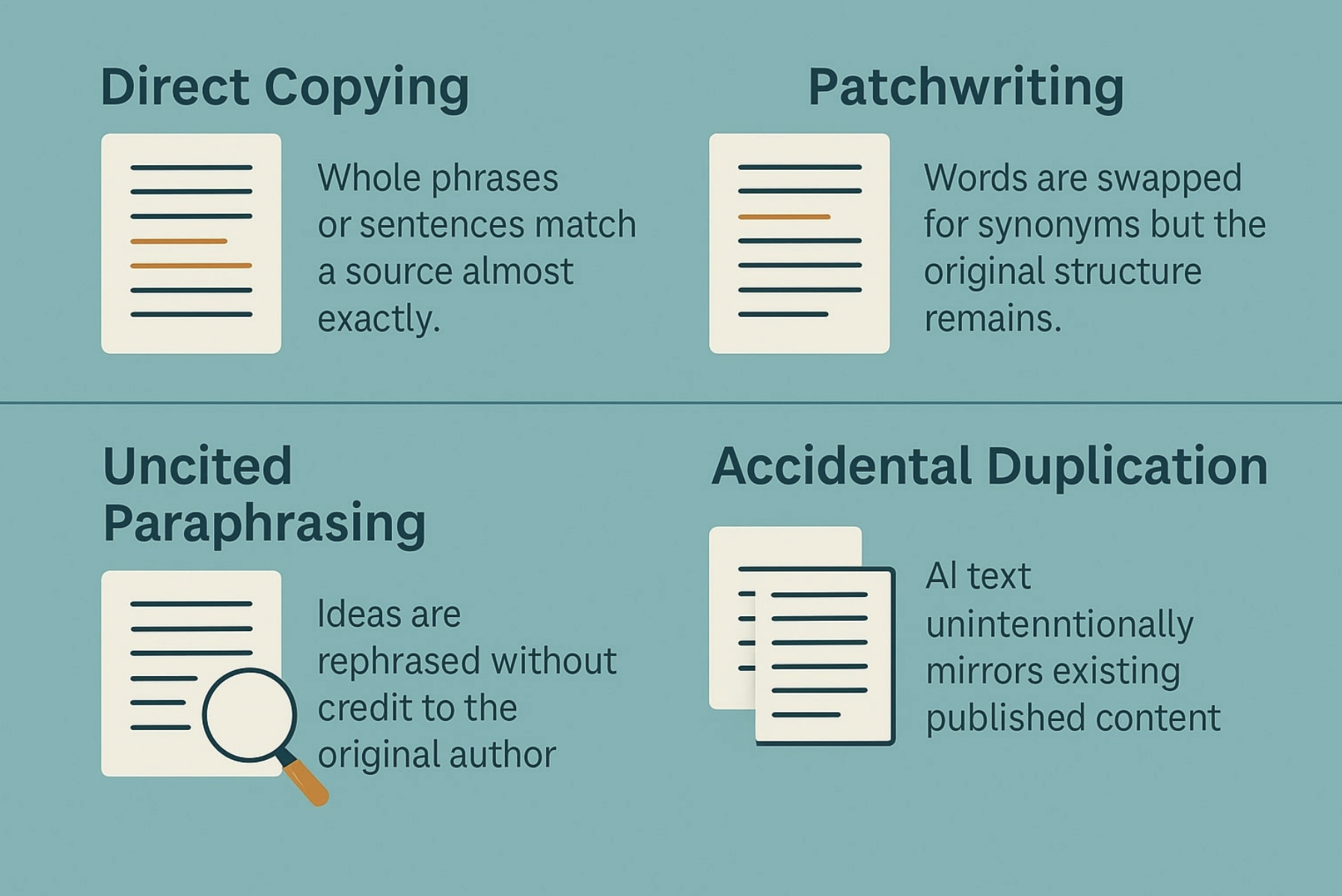
- Direct Copying: This is the most obvious form: whole phrases or sentences match a source almost exactly. An AI model may spit out familiar lines because it was trained on a massive amount of publicly available text. If those lines reappear in your project without credit, they look like borrowed work.
- Patchwriting: This one is sneakier. Imagine you feed AI a chunk of text, and it swaps out a few words for synonyms but leaves the structure nearly identical. On the surface, it looks different, but underneath, the bones of the original remain. Academics often flag this as plagiarism because it shows the writer hasn’t fully digested and re-expressed the idea.
- Uncited Paraphrasing: Even if the AI rewrites content into brand-new sentences, the ideas still belong to the original author. This is where citations come in: they don’t just pad your reference list, they prove you’re giving credit where it’s due.
- Accidental Duplication: Because language models are trained on enormous libraries of content, they may produce passages that closely resemble real articles or books. You may not recognize it as copied, but plagiarism detectors often will.
So, while plagiarism always means “to take credit for what isn’t yours,” AI complicates the picture because its outputs blur the line between original creation and recycled language. The safest way to handle this is to treat AI text as a starting point, not a finished product. And now we will show how to humanize AI text.
5 Best Methods to Rephrase AI Text Without Plagiarism
AI-generated text often sounds polished at first glance, but under the hood, it can read formulaic and repetitive. The real task is to reshape the text until it reflects a human rhythm and clear respect for the original ideas.
We will cover the main ways to do exactly that. When combined, these strategies do more than avoid plagiarism. They also help you avoid robotic tone in AI-generated blogs and articles, and produce text that feels authentic.
1. Use AI Humanizers and Paraphrasing Tools
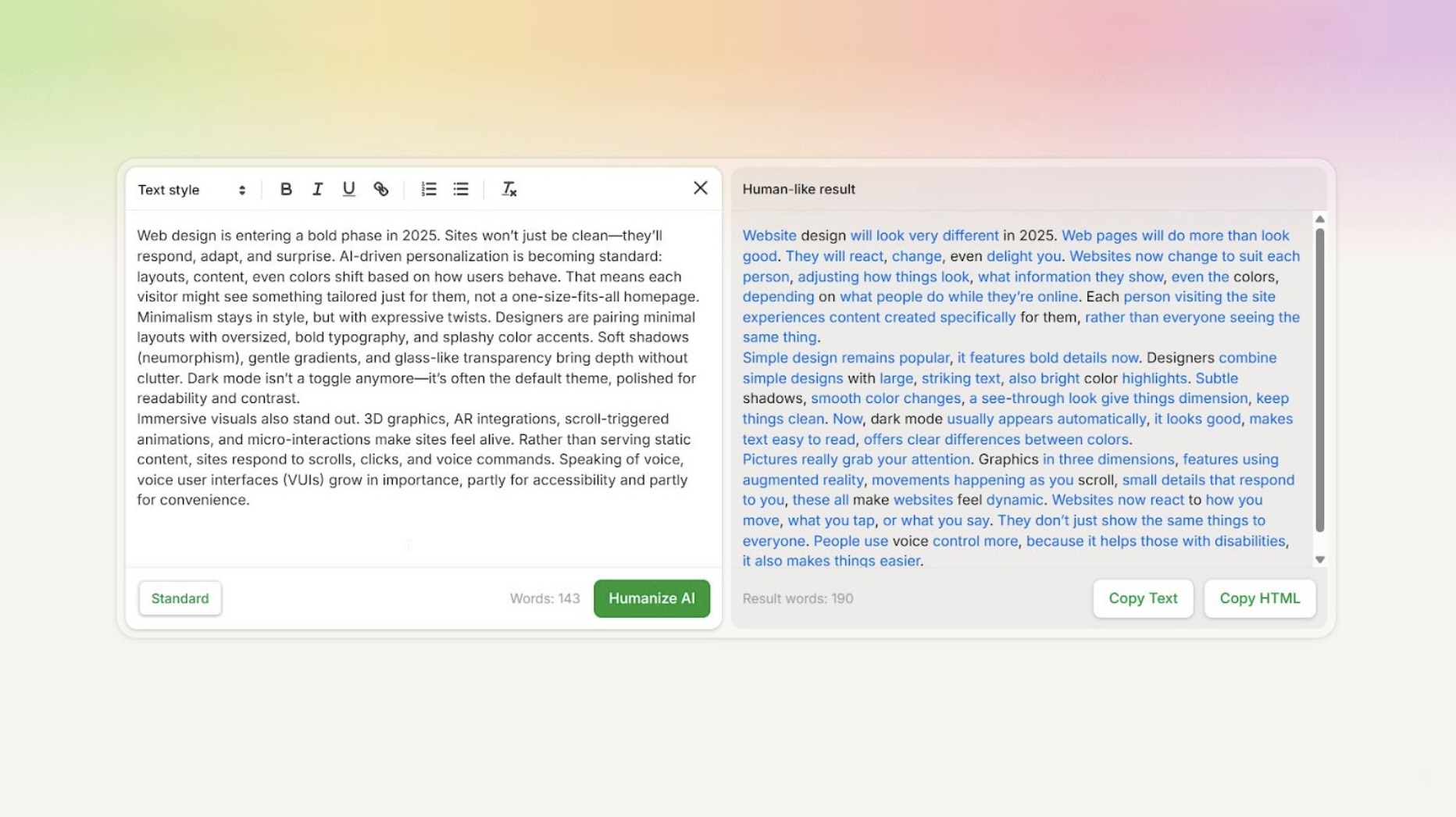
AI humanizing tools, such as Clever AI, QuillBot, Grammarly, and Wordtune, are often used to rephrase text so it reads more naturally and avoids overly close duplication. They serve best as a starting point: generate alternative phrasing, then refine the draft in your own words to ensure clarity and originality.
For those exploring cost-effective solutions, some users search for the best free plagiarism AI humanizer to handle basic rephrasing tasks without needing to pay for advanced software. These tools typically allow you to paste AI-generated text into an input box, process it, and return a rephrased version within seconds. While helpful, they may include word count limits or fewer features than premium tools.
2. Break the AI Rhythm
AI text often feels like it was produced with a cookie-cutter. Sentences follow the same predictable structure, which creates obvious overlaps with published material. Plagiarism detectors don’t just check vocabulary; they also look for syntactic patterns. If your sentence order mirrors the source too closely, the software treats it as copied content.
To overcome this, focus on reshaping sentences completely. Split long sentences into shorter ones when it helps clarity. Merge choppy fragments into fuller statements when the flow needs improvement. Switch the order of ideas so your draft doesn’t trace the same path as the original.
Tools such as Grammarly or Hemingway Editor can help highlight overly complex structures and suggest clearer alternatives.
3. Cite Sources to Acknowledge Ideas
It’s a common mistake to believe that paraphrasing automatically removes the need for references. If AI text rephrases a statistic from a research paper or reshapes a concept from a published article, we still need to cite the source. For example, the APA Style guidelines make it clear that paraphrased material requires proper in-text citation, just like direct quotations (see APA’s official guide).
It’s also important to realize there isn’t just one universal way to cite. Different fields and institutions rely on different standards: APA, MLA, Chicago, IEEE, and others. A university might insist on APA, a publisher could require Chicago, and some companies enforce their own internal policies. We encourage you to check the specific requirements of your school, university, workplace, or publisher before you submit your work.
4. Choose Words with Context in Mind
One of the easiest mistakes people make is surface-level synonym swaps. AI does this too: it might replace “important” with “significant” or “big” with “enormous,” but those changes don’t break plagiarism links. In fact, detection tools often ignore synonyms because they look at sentence structure and context. A safer approach is to look at the idea, not the word. Ask yourself: How would I explain this concept to a colleague or a friend? That’s when context-aware synonyms come into play.
5. Prefer Active Voice
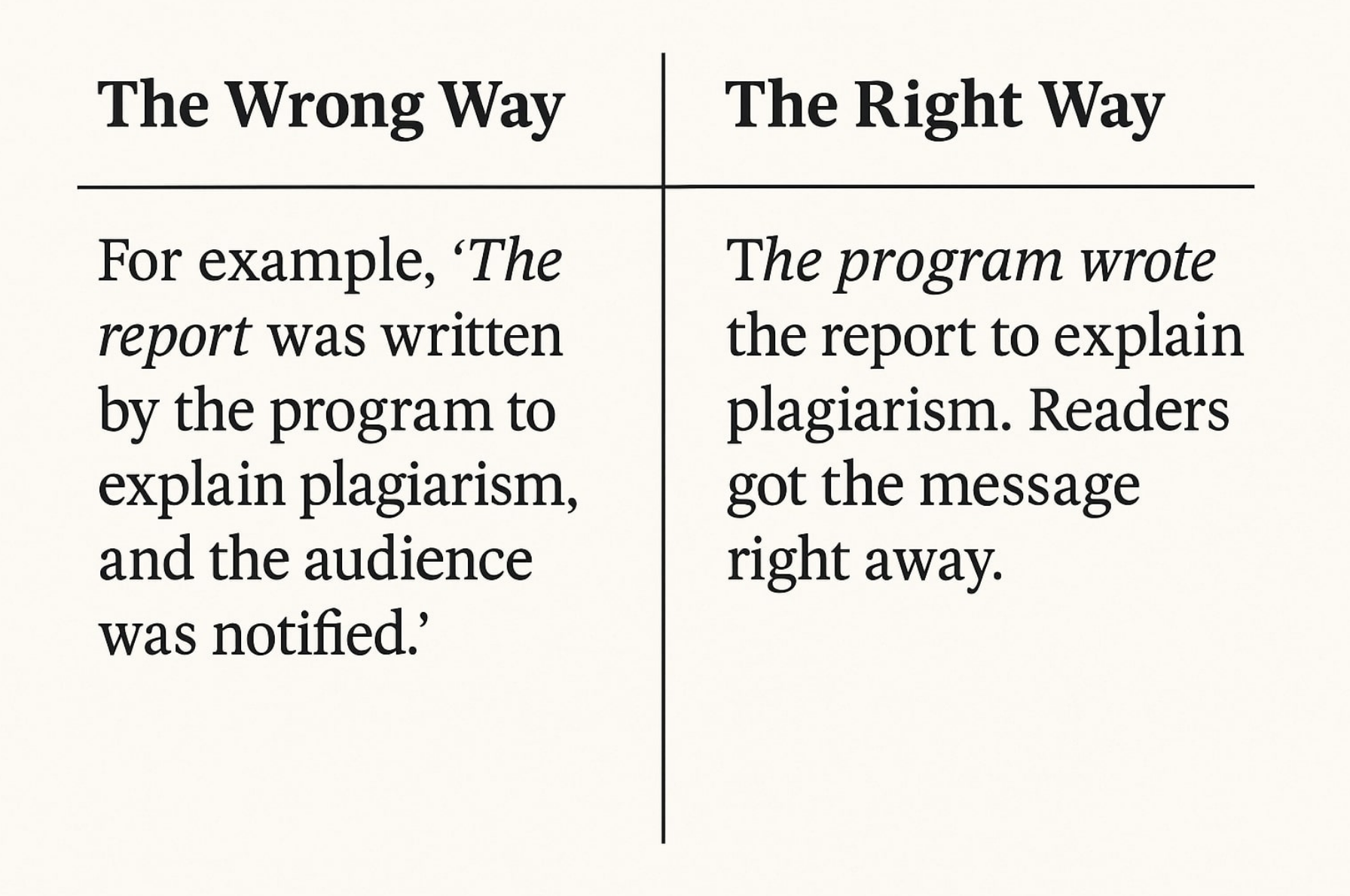
AI loves passive voice because it’s safe and formulaic, but that style often mirrors published sources too closely. Passive phrasing reduces your control over the sentence and makes it harder to make substantial changes. Active voice, on the other hand, puts the subject front and center, giving you more opportunities to reshape the sentence.
This change looks small, but it has big consequences for plagiarism risk. Passive forms have fewer possible variations, while active forms open up flexibility. That flexibility is what gives you space to rephrase sentences in multiple ways. You can even use AI itself for this purpose: with a prompt like “Rewrite this in active voice,” the tool can quickly flip stiff passive sentences into clearer, more adaptable ones. From there, you can polish the result with your own style.
Check Your Text After Rephrasing
Even after you carefully rephrase your text or use a free plagiarism checker and humanizer tool, hidden overlaps can remain. That’s why plagiarism checkers are the last line of defense. Tools like Copyscape, Turnitin, or Grammarly’s checker compare your text against massive databases of published content.
But here’s the catch: similarity percentages alone don’t tell the full story.
A 10-15 percent overlap is often unavoidable because common phrases are everywhere. The plagiarism risk appears when whole sentences or unique phrasings match another source. That’s why you should treat similarity reports critically. If the flagged section contains technical definitions or unavoidable wording, it’s fine. If it shows long strings of familiar text, it’s time to rewrite.
Wrapping Up
The safest way to rephrase AI text is to combine approaches. Restructure sentences, use active voice, cite sources when ideas aren’t your own, and check the final draft with plagiarism tools. A free AI text humanizer can help smooth out robotic sections, but your edits and personal style give the text authenticity.
This thoughtful editing process is not only about improving clarity—it also helps protect against bigger risks. As shown in this USA Today report, false AI-related allegations have harmed students by lowering grades, threatening scholarships, and affecting mental health. Careful editing helps ensure originality and reduces the chances of plagiarism or AI detection issues.
 FAQs
FAQs
To humanize AI content means to rewrite computer-generated text so it reads as if a person wrote it. Paraphrasing, on the other hand, only rewords sentences to avoid duplication and keeps the original meaning intact. When you humanize AI text, you go a step further: you adjust style, add context, smooth transitions, and sometimes insert personal insights or examples. Paraphrasing reduces similarity, but humanizing makes the text engaging and authentic.
Use a citation whenever the AI output includes facts, statistics, definitions, or arguments that clearly trace back to a published source. Even if the phrasing has been reworked, the intellectual ownership of the idea still belongs to the original author. In practice, this means citing studies, news articles, reports, or any other identifiable external material. Citations protect you from plagiarism claims and signal credibility, especially in academic or professional writing.
No, free AI humanizer can't promise complete originality. These tools to humanize plagiarism are designed to rephrase text and lower AI detection scores, but they cannot fully eliminate overlaps with existing sources. Plagiarism checkers often pick up on repeated phrases or familiar structures regardless of how “human-like” the text sounds. Even the best humanizer should always be followed by manual editing and a plagiarism scan.
Free tools like Clever AI Humanizer or QuillBot (free tier) can handle chunks of 1,000 words per run and more. If your writing is over the limit, break the draft into sections, process them separately, and then edit for flow.
You can’t guarantee 100% removal, but you can get as close as possible by rewriting deeply instead of just swapping synonyms. Change sentence structures, switch to active voice, and inject your own examples or perspective. Cite sources when ideas aren’t yours, and always run a plagiarism checker afterward. Combine these steps with humanizer tools to lower overlap and keep the final text original.
Featured Image by Freepik.
Share this post
Leave a comment
All comments are moderated. Spammy and bot submitted comments are deleted. Please submit the comments that are helpful to others, and we'll approve your comments. A comment that includes outbound link will only be approved if the content is relevant to the topic, and has some value to our readers.
Comments (0)
No comment