
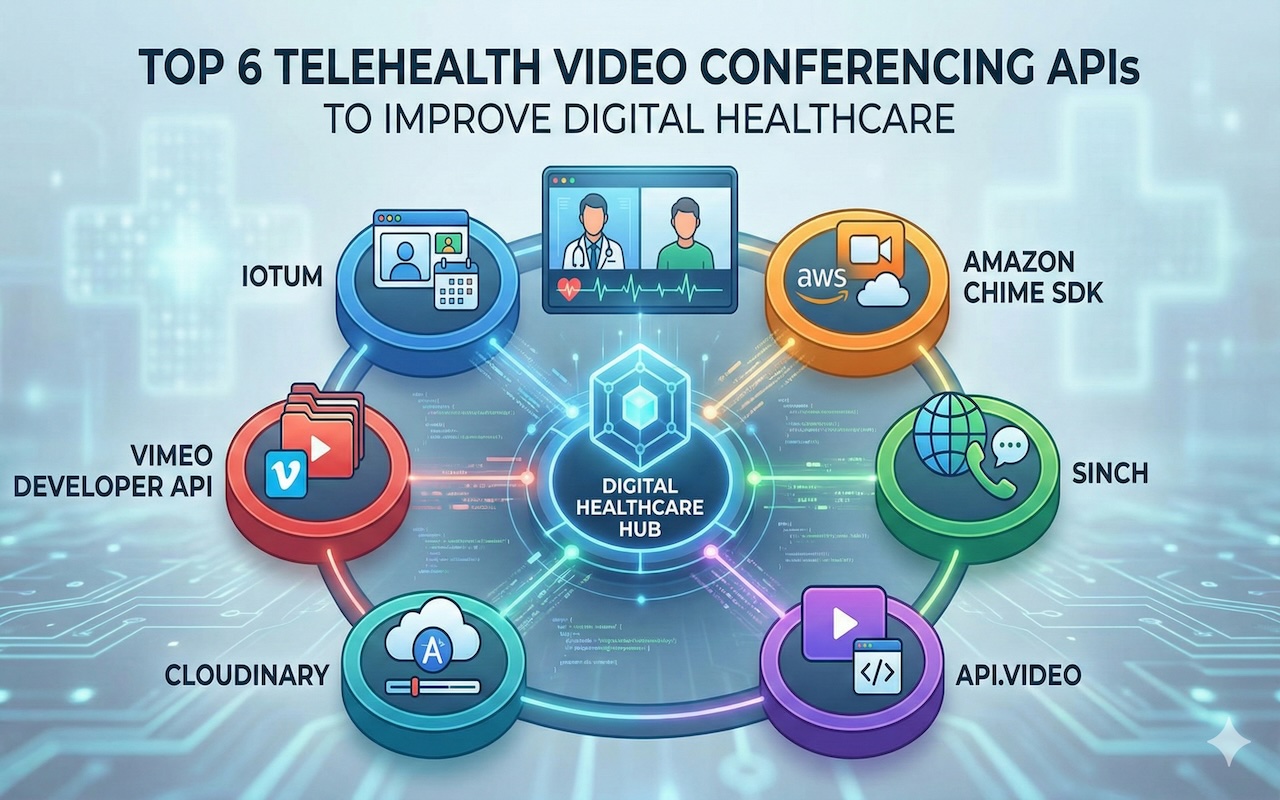
Telehealth completely changed how we get medical care. Americans have embraced these services, with 90% using them in 2022. These numbers really talk. Patients typically wait 26 days to see a doctor in person and 31.4 days for an OB-GYN. Virtual care provides help right away.
Telehealth video conferencing has become a permanent part of healthcare. The technology continues to expand with market projections showing a 5.1% yearly growth rate. The expected value should reach $156.7 USD million by 2033.
Healthcare providers just need reliable telehealth API video platforms to serve their patients.
Today, in 2024, the digital systems managing everything from appointments to test results truly build modern medical care.
We researched the top telehealth API so you can pick the perfect one.
You'll find 6 powerful ways to upgrade your digital patient services here.
1. Iotum
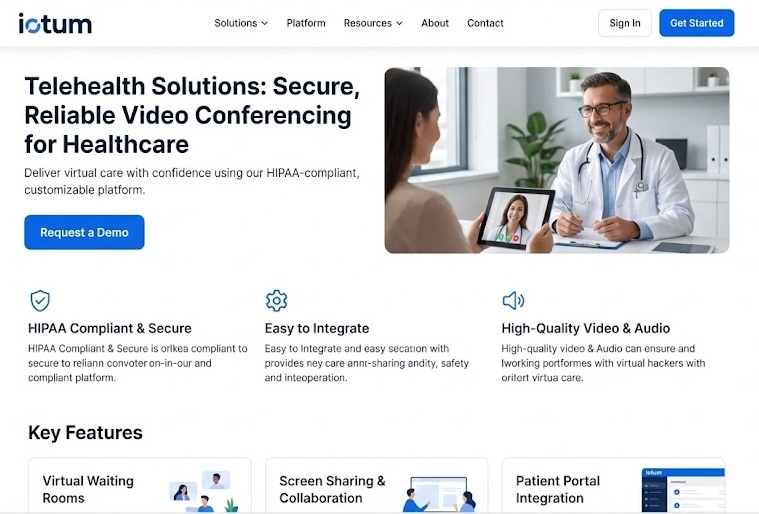
Iotum provides a HIPAA-compliant, browser-based video/voice API designed to embed telehealth into existing apps with minimal development. It covers appointment workflows, remote consultations, and post-visit analytics, plus SDKs for web and mobile.
API Features
- Appointment Management: Scheduling API with SMS/email invites and automatic/custom reminders.
- Remote Consultation Toolkit: Download-free video/voice, dial-out, text chat, document/screen sharing, waiting room, live video annotation, recording, and closed captions. Works on any device.
Pros
- End-to-End Telehealth Flow: One stack covering booking → consult → analytics.
- Fast to Embed: Plug-and-play APIs/SDKs for web and mobile.
- Patient-Friendly Experience: No downloads required, works on any device, includes accessibility captions.
- Strong Compliance Posture: HIPAA alignment, security controls, and data-sovereignty options.
- Post-Visit Insights: AI transcription and sentiment analysis to help improve care quality.
Best Use Case
Clinics, hospitals, and multi-site practices needing secure, branded telehealth built into existing portals/EMRs. Digital health startups that want a white-label video layer without building RTC/compliance from scratch. Remote care programs (follow-ups, specialist consults, rural access) and medical education/training scenarios (multi-camera, live annotation).
2. Amazon Chime SDK
Amazon Web Services has entered the telehealth space with Amazon Chime SDK. Healthcare teams get all the tools they need here to start offering patient visits online without a hitch. Most healthcare groups consistently choose this first. Yet Amazon Chime SDK brings powerful features backed by AWS infrastructure.
API Features
- High-Quality WebRTC Media: Standard sessions support up to 250 participants with 720p video and 1080p screen sharing; high-definition sessions allow 25 participants with 1080p video and 4K screen sharing.
- HIPAA Compliance: Meets professional healthcare requirements for secure communications.
- Live Transcription: Amazon Transcribe Medical provides automated clinical notes and analysis.
Pros
- Global Network Reliability: AWS's extensive infrastructure gives Amazon Chime SDK worldwide coverage and stability that smaller providers can't match. Healthcare organizations avoid service disruptions such as the recent Twilio Programmable Video shutdown.
- Seamless AWS Integration: Works naturally with other AWS services. Teams using Amazon Connect can add “Click to Call,” unifying messages and calls in one place.
- Cost Advantages: The platform is 57.5% cheaper than Twilio’s comparable service. Organizations with AWS Enterprise Discount Plans can also apply usage toward spending commitments, simplifying contracts and cost management.
- Strong Security and Compliance: Backed by major certifications—including FedRAMP, HIPAA, PCI, and SOC—allowing healthcare providers to build secure virtual care systems that protect patient data.
Best Use Case
Large-scale telehealth implementations benefit most from Amazon Chime SDK. Amazon Clinic uses the SDK for video communication and launches 50% faster than other solutions.
This SDK truly excels at making custom virtual doctor visits happen. Picture bringing together old-school phone chats, video calls over the internet, quick text messages, and even helpful nudges for your schedule. Developers can build virtual waiting rooms where patients check in before doctor consultations.
Healthcare networks can use ready-to-deploy components to add telehealth widgets to any webpage with minimal code. You'll discover this SDK is just right for building online tools, whether those are for doctors or for patients.
This SDK truly shines for health groups already using a lot of AWS, or for anyone wanting to build their telehealth apps just right.
3. Sinch Voice and Video API
Sinch packs a punch in telehealth video with its complete Voice and Video API. Even with those points, Sinch truly impresses. It offers a solid option for healthcare providers who must reach people globally.
API Features
- Global Reach: Local and toll-free numbers across 70+ countries and 16,000+ cities.
- Secure Infrastructure: Distributed across five AWS regions to ensure optimal call quality.
- Real-Time Control: Live webhooks with JSON callbacks that integrate seamlessly with healthcare systems.
The platform handles over 300 billion minutes of voice traffic each year. You'll see it works for the biggest health systems.
Pros
- Reliable Network Infrastructure: Sinch owns its entire network stack, offering stability competitors can't match. Its U.S. Super Network connects to a global system with geo-redundant data centers and a 99.95% uptime SLA.
- Strong Security and Compliance: Sinch provides end-to-end encryption (TLS/SRTP), IP access controls, and adheres to GDPR, ISO 27001, and STIR/SHAKEN standards. With HIPAA accreditation, medical organizations can trust patient data protection.
- Seamless Workflow Integration: The platform makes app-to-app communication simple. Healthcare providers can keep their existing workflows while adding telehealth capabilities through pre-built connectors for Salesforce, SAP, Genesys, and more.
- Cost-Effective Pricing: Users often find the costs surprisingly budget-friendly. Video calling is free for the first 2,500 minutes per month, with a low rate of $0.01 USD per minute after that.
Best Use Case
Healthcare organizations that need global telemedicine capabilities will find Sinch excellent. Doctors can reach patients in remote locations where medical care is hard to access, thanks to stable connections in rural areas.
Healthcare networks looking to simplify their vendor setup will find a perfect fit. Sinch's unified communications suite brings voice, messaging, email, and verification to one platform. Hospitals with many different conversations happening at once will find this incredibly helpful.
When Sinch puts telemedicine into action, you'll see some seriously good results. Their customers cut regular patient care costs by 11% while getting more than 3x return on investment.
White-labeled telehealth applications work great with Sinch. The cloud-based architecture, well-documented WebRTC SDKs, and built-in signaling technology make communication infrastructure simpler for developers.
4. Api.video
Developers who want to build custom telehealth video platforms will find api.video's approach is efficient.
API Features
- Adaptive Bitrate Streaming: Automatically adjusts quality based on patient connectivity
- Player SDK: Customizable white-label video player that fits any healthcare interface
- Live Streaming: Supports immediate consultation with recorded content
The API manages both live and on-demand video through RESTful endpoints. As a provider, you get the best of both worlds here. Connect with patients live for urgent needs, or let them send messages whenever it fits their schedule.
Pros
- Developer-First Approach: The sort of thing I love about api.video is its developer-first approach. You'll find the documentation packed with coding examples for popular languages like Node.js, Python, PHP, and Ruby.
- Clear, Scalable Pricing: Clear pricing is a big advantage. Unlike competitors who hide fees, api.video uses simple pay-as-you-go pricing that grows with usage. Expanding virtual clinics will find this especially helpful.
- Strong Privacy and Compliance: We keep your patient information completely safe, following every medical data rule. Video calls for online health visits stay completely private here. A digital token, like a secret key, guards all your personal medical information.
- Reliable Infrastructure: The reliable infrastructure handles technical complexity through simple API calls. Medical developers get to create health tools, not battle video playback glitches.
- Full Branding Control: Api.video's customization options give healthcare brands total control over patient experience. Everything from player colors to interface elements can match your medical practice branding.
Best Use Case
Healthcare organizations building asynchronous telehealth applications will benefit most from api.video. This API skillfully brings together patient video calls and helpful learning videos.
It's spot-on for any business just getting started in healthcare. The flexible infrastructure grows with your patient base without major platform changes. You pay for what you use early on and scale up as your practice expands.
Educational medical institutions get exceptional value from api.video's capabilities. The platform handles educational video libraries and live streaming lectures through the same API endpoints.
Healthcare providers can add video features step by step to existing platforms with api.video. Providers can test new telehealth features slowly before they launch everything.
5. Cloudinary Video API
The Cloudinary Video API packs strong tools healthcare groups are sure to find valuable. Imagine having one online place for all your video. This system handles every step of your telehealth video sessions, from scheduling to secure playback.
API Features
- AI-Powered Accessibility: AI-powered accessibility - Meets WCAG 2.1 AA standards with features like non-text contrast, focus indicators, and tab navigation for screen readers
- Automated Captioning: Automated captioning - Creates subtitles automatically and lets you customize styling to highlight text
- Transcript Generation: Transcript generation - Makes searchable transcripts that help people find videos easily
The platform handles uploads up to 100GB with instant encoding, making it perfect for long telehealth sessions.
Pros
- Easy Video Management: Developers love how Cloudinary makes video management easy. The API-first approach offers SDKs for most programming languages, so healthcare developers can combine video smoothly with existing systems.
- Strong Data Protection: Your data's safety is a priority here. We've built solid protections that provide substantial confidence. Confidential patient data is safeguarded by cryptographic URLs and a robust framework of access permissions. Healthcare providers can ensure patient data stays confidential during video consultations.
- Useful Analytics: You'll also get solid numbers from the platform. This means you can easily tell how patients are watching and responding to your health videos. We use this data to make your virtual health appointments much better.
- Flexible, Scalable Pricing: Your costs adjust automatically as your practice gets busier. Healthcare providers starting with telehealth video conferencing will benefit from this pay-as-you-go model.
Best Use Case
Healthcare organizations needing accessible telehealth platforms will get great value from Cloudinary. Accessibility features are part of our platform right out of the box. This saves development time. It's especially useful with the European Accessibility Act coming in 2025.
Medical education institutions can take full advantage of Cloudinary's capabilities. The same API manages both educational video libraries and live demonstrations.
Cloudinary fits healthcare providers who want a complete video solution. Beyond simply providing efficient virtual consultations and secure patient communication, this digital interface thoughtfully incorporates functionalities that accommodate diverse user needs for unimpeded access.
6. Vimeo Developer API
Vimeo Developer API wasn't built specifically for healthcare, but it has video capabilities that work well for telehealth needs.
API Features
- Complete Endpoint Architecture: Connects to various resources like videos, users, showcases, channels, folders, and groups
- Flexible HTTP Request Structure: Uses standard methods for API communication with clear documentation
- High-Quality Playback: Supports stunning ad-free 4K Ultra HD video playback
The platform supports 360 video capabilities and delivers an immersive experience that could boost remote medical examinations.
Pros
- Strong Privacy Controls: Vimeo handles private information really well, a big deal for any online health service. They keep your content safe with passwords, specific domain settings, and shareable private links.
- Easy Email Integration: Getting email addresses is simple with our solid setup. It connects directly to your existing email services, including MailChimp, so everything just clicks. Healthcare organizations can manage patient communications better this way.
- Powerful Content Management: Vimeo shines at content management. Vimeo's standard options provide solid features. See detailed analytics and get your videos playing perfectly.
- Developer-Friendly API Reference: Healthcare providers building custom telehealth solutions will find a well-laid-out API reference. Every method, endpoint, field, and value crucial for development projects is spelled out within these pages.
Best Use Case
Vimeo Developer API serves healthcare organizations that need video content libraries rather than live consultation platforms. Need to learn something new, hear from others, or get medical advice on video? This service gathers all those important things in one spot.
Small telehealth providers benefit from Vimeo's multi-user management features. When more people on a team can handle video tasks, everyone works faster. This really helps healthcare groups that share many duties.
Final Verdict
Getting medical help looks totally different now. Online platforms let patients talk to their doctors from anywhere.
Our exploration of these top 6 telehealth video conferencing APIs reveals some of the best tools for healthcare organizations that want to implement virtual care solutions. Their HIPAA-compliant platform combines security, smooth integration, and excellent performance in areas with limited connectivity.
Consider what each option offers; your decision should truly fit your individual health situation. To cite an instance, Amazon Chime SDK works well for AWS-invested organizations, while Sinch excels in international telehealth applications. Cloudinary gives easy access to all users. This helps healthcare projects make sure no one is left out.
Telehealth continues to grow rapidly. Doctors and hospitals adopting new tech today will deliver better care and stand out from the rest. As new rules appear and patients want more, a solid video conferencing tool really matters.
Technical capabilities matter, yet patient experience drives telehealth success ultimately. The right platform should become invisible, letting doctor-patient relationships flourish. Your clinical workflows should guide the selection of each option.
Healthcare organizations of all sizes can find suitable entry points among these reviewed tools. Starting small makes sense, even simple video conferencing can improve care access significantly. Your telehealth program naturally offers more services and tools as it expands.
Your future healthcare will be built on virtual choices. The right telehealth video conferencing API today will help you serve patients wherever they are tomorrow.
Featured Image by Freepik.
Share this post
Author

Read the latest articles from Cory Wells
Top 7 Construction Drawing Management Software Simplifying Complex Projects

December 6, 2025
Construction projects move quickly, and even small disconnects in drawings or revisions can cause delays, cost overruns, or rework. As teams grow more distributed across offices, field sites, and subcontractor networks, the need for reliable drawing management has become essential—not optional.
Learn moreHow Trusted Cross-Platform App Development Agencies Shaping the Future of Mobile Experiences

November 20, 2025
Choosing the right cross-platform app development company can define your digital future. These agencies combine technical mastery, user insight, and business strategy to deliver performance-driven mobile solutions.
Learn moreLeave a comment
All comments are moderated. Spammy and bot submitted comments are deleted. Please submit the comments that are helpful to others, and we'll approve your comments. A comment that includes outbound link will only be approved if the content is relevant to the topic, and has some value to our readers.
Comments (0)
No comment