
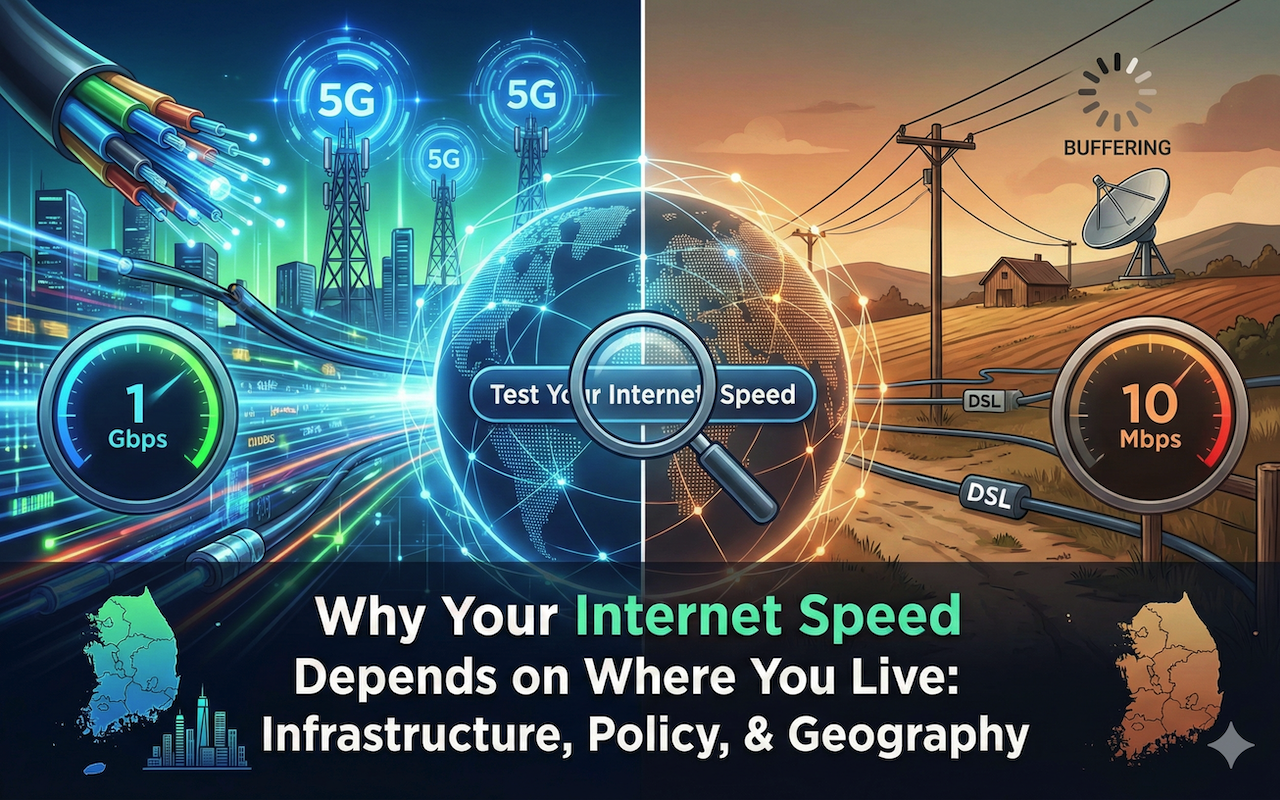
Many of us think that we have the best connection until it decides to take a break. It can happen for many reasons, such as local infrastructure, government regulations, and regional connectivity challenges.
That's why it's recommended to test your internet speeds daily so you can see how your connection compares to what is expected in your area.
This simple step often reveals just how much geography influences the quality of your online experience, or if the problem lies at your own end (faulty/outdated equipment).
In this guest post, I'll walk through the key factors that shape internet speed, from the strength of local infrastructure to government policies and regional connectivity limitations.
By the end, you'll have a clearer picture of why online performance can look so different depending on where you live. So, let's get started!
Common Factors Affecting Internet Speed
Local Infrastructure
Over the last two decades, internet speeds have improved significantly due to infrastructure development. Whereas some nations, especially developing countries, are still struggling with slow, unreliable internet connections.
Internet speeds vary by around 100 Mbps across countries, according to the Global Speed Test Index. For example, Switzerland and South Korea have internet speeds ranging between 200-300Mbps, while third-world countries like India and some parts of Africa offer less than 20Mbps.
This is because the infrastructure facilities are unable to meet the growing demand for a strong broadband connection.
Countries like the US, Japan, and South Korea, which have advanced telecommunications infrastructure, are investing heavily in 5G and high-quality fiber-optic networks to provide their users with the best Wi-Fi speeds.
South Korea is one of the countries with the best fiber-optic and 5G internet providers, as the country has the highest percentage of full-fiber broadband connections in the OECD (Organization for Economic Co-operation and Development) and ranks highly for 5G base station density and download speeds. A significant portion of its mobile traffic is on 5G, with average speeds reaching over 1 gigabit per second in major cities.
In developing countries, connections are not as fast as in developed ones, due to outdated technology and equipment. Even in places where the internet is available, there may be issues with consistency and reliability, especially in rural or remote areas, where poor infrastructure compromises speed.
Government Policies and Regulations
Government regulations and policies can impact the quality and speed. Many developed countries, such as South Korea, China, and Dubai, have made this their top priority, offering incentives to private companies and investing in fiber-optic networks.
Whereas countries with no regulatory restrictions or government interventions experience slower speeds.
Scandinavian countries like Finland and Sweden benefit greatly from strong government support, which enables the private sector to build high-speed networks, allowing these nations to be leaders in the market.
Government funding and investment are another factor that varies the broadband speed by location. Federal and state programs like the Infrastructure Investment and Jobs Act's BEAD program and the USDA's ReConnect Program provide billions of dollars in grants and loans to expand high-speed broadband infrastructure, particularly in unserved and underserved rural areas.
This directly leads to faster connections in those specific communities where private companies might not find it profitable to build without assistance.
The lack of competition in many areas means incumbent ISPs have little incentive to invest in expensive upgrades for faster speeds or better service. Policies that encourage competition, such as allowing municipal broadband networks, can force providers to improve their services.
Connection Availability
Speeds differ within countries, and they differ within countries as well, since rural and urban areas do not experience the same speeds.
In highly populated urban areas, a fast connection is readily available, as people have access to fiber-optic connections with speeds of more than 100 Mbps.
People living in urban areas are the first ones to get new technological advancements, such as gigabit fiber and 5G, because of a high demand in the market.
People in rural areas rely on satellite or DSL connections. This is because of the poor infrastructure facilities there, and people living there cannot enjoy high speeds. Rural broadband access in the United States remains a challenge, as many areas still lack high-speed, reliable connections.
The same thing also exists in other countries, like India, where big cities like Mumbai and Delhi experience faster speeds than rural areas.
Final Thoughts
Internet speed is shaped by technological advancements that bridge the gap between low- and high-speed regions. 5G is revolutionising the telecommunication landscape by offering faster mobile connections as compared to the previous generations.
SpaceX's satellite technology is all set to offer high-speed access to areas where traditional broadband infrastructure is not available.
Advancements like these have the potential to bring fast connections to every corner of the world.
Featured Image generated by Google Gemini.
Share this post
Author

Leave a comment
All comments are moderated. Spammy and bot submitted comments are deleted. Please submit the comments that are helpful to others, and we'll approve your comments. A comment that includes outbound link will only be approved if the content is relevant to the topic, and has some value to our readers.
Comments (0)
No comment